Tuesday, January 26, 2010

Thoughts on Haiti: Huaraz All Over Again

In 1970, an earthquake the magnitude of 7.7 on the Richter scale hit off the coast of Peru and devastated the Andean department of Ancash, taking the lives of an estimated 80,000 people. Another 3 million were affected, making the quake the largest natural disaster in Peruvian history. Huaraz, Ancash’s capital city, crumbled to the ground. Ancash’s smaller villages were demolished; the adobe houses and buildings didn’t stand a chance. The quake destabilized the northern wall of Mount Huascaran, and towering at over 22,000 feet, the wall of the glacier broke off, creating a landslide of epic proportions that buried the urban town of Yungay. Only a couple hundred children and teachers survived the Yungay landslide because they were hiking on hills above the city, above the destructive reaches of the mud, ice, and debris that buried their town and families in the blink of an eye. The surviving children were dispatched to orphanages around the world.

Almost 40 years later, another massive earthquake devastates the impoverished island nation of Haiti. The statistics are shockingly similar: both Ancash and Haiti were impoverished areas before the earthquakes, both quakes left over 50,000 people dead and around 3 million affected, and both quakes completely destroyed basic and vital national infrastructure.

Today, Ancashinos sit in their adobe houses listening to the news come in about Haiti and are bitterly reminded of a not so far away past when they were living the same horror. Politicians and international aid workers should turn to Ancash as a developmental case study to help maneuver the unsteady waters of Haiti. What happens to an already impoverished society when a natural disaster strikes?

The earthquake in Ancash affected every aspect of the campasinos’ life, from family, culture, economy, infrastructure, and personal identity. Homes turned to dust. Crop fields were destroyed. Livelihoods were lost. Parents, siblings, and friends perished into the ground. Communities were destroyed. Access to drinkable water became the key to survival. The shock these losses take on a person’s self-esteem and self-worth are immeasurable. Peru lacked the resources to help their own people and turned to the outside world for rescue. What resulted in Ancash was a massive influx of international aid and support; richer, developed nations and organizations like the Inter-American Development Bank and the World Bank sent food, medicine and manpower in hoards. Survivors of the earthquake in Tumpa, my Peace Corps hometown, tell me about the planes that would drop boxes filled with clothes and medicine out of the sky.

One of the major challenges Peace Corps volunteers in Ancash face today is what we call the “culture of receiving.” Since 1970, Ancashinos have become accustomed to receiving international aid, mostly in the form of money. Whether the financial aid comes from NGOs with health, educational or micro-business missions, or from mining companies seeking to pacify exploited communities with quick and glamorous development projects, Ancashinos are in the habit of receiving money. Eager Peace Corps volunteers who are broke by default seek opportunities to start grassroots development projects, but often are not taken seriously, because to the Ancashino eye, a Gringo equals a greenback. Starting sustainable development projects in the Ancash communities without applying for grants is difficult and rare. And this might be because of how the outside world reacted to the earthquake of 1970.

When a national disaster strikes, basic human morality implores those of us capable to help those of us in need. International financial aid and involvement over a period of time is certainly necessary after major natural disasters wreak havoc on impoverished societies like Ancash and Haiti. But once the proverbial dust has settled, is continued international aid sustainable? When does international financial aid stop helping and start stripping a society of its national fabric and sovereignty? What happens to national and personal responsibility and self-esteem? In Tumpa, I often encounter a general lack of motivation, low self-esteem and apathy in the townspeople. Is 40 years of outside financial involvement more beneficial or detrimental to the growth and development of people from societies like Ancash? Did our morality in 1970 take a long-term demoralizing effect on these people?

Alternatives to long-term international financial involvement in response to natural disaster situations could include development programs like the Peace Corps Response, whose volunteers donate a few months to a year to educate people on healthy lifestyle techniques or micro-business strategies to help in the transition from crisis situations to peace. More widely known is the Peace Corps, whose volunteers live and work in developing countries partnered with host country nationals who seek to empower positive change and growth in their own communities. One human being extending a helping hand to another, offering knowledge instead of cash, is a resource that should not be underestimated. The international community should examine alternative options to financial aid that help developing communities transition to build their own countries with dignity so the citizens can really “own” their development.

Despite our academic knowledge, history continues to repeat itself. The role of international aid in times of crises like these must be examined carefully. If the Haitian people want to become a sovereign, self-sufficient, developing nation, the international community might examine appropriate alternatives to providing aid other than throwing money at the problem. Otherwise the Haitians might rely too heavily on financial support for the foreseeable future, obstructing the way for organic national development.


*Special thanks to Tim for inspiring me to write this.

Wednesday, January 13, 2010

Healthy Schools Program, Tumpa, Peru


Since my arrival in Tumpa, I have worked on the Healthy Schools Program with the Health Post and Santa Fe school to reinforce healthy lifestyle behaviors in the youth, specifically in the areas of hygiene, nutrition and environmntal awareness. We have tackled these health problems with the youth by discussing and pacticing handwashing, bathing, toothbrushing, healthy meals, and trash management. After over a year of training and preparation, my Healthy Schools Program in Tumpa is becoming a reality! Peace Corps, Washington has approved my grant proposal and posted the project to the Peace Corps website. We are ready to take the Healthy Schools Program to the next level, and we need your help! Please pass on this email to any philanthropic friends who would like to donate and improve the lives of the Peruvian youth in my community. Below you will find a brief description of my project with instructions on how to donate.

Hygiene, nutrition and envionmental practices in Tumpa´s youth are very poor. Healthy lifestyle behaviors are seldom taught or reinforced in the home or school. Tumpa´s Health Post and Santa Fe school see the opportunity to strengthen healthy lifestyle behaviors in Tumpa´s youth through dynamic trainings and workshops; however, materials and supplies like trash cans and soap dispensors that reinforce these behavior changes do not exist and are needed. I need your help to improve healthy lifestyles in my Peruvian students!

Please visit the Peace Corps website to view the Healthy Schools Program profile, and please donate to improve the lives of my Peruvian students!


Go to the Peace Corps website at: peacecorps.gov
Click on ¨Donate Now!¨
Enter my last name ¨Dila¨ or my project number 527-015

OR
Click on this link: https://www.peacecorps.gov/index.cfm?shell=resources.donors.contribute.donatenow
and enter Peru in Search by Country of Service

Muchisimas Gracias!

****
¨La posibilidad de realizar un sueño es lo que hace que la vida sea interesante¨ -Paulo Coelho

Monday, January 11, 2010

Año Nuevo


Happy New Year! This Christmas, Carl and Franceen met me in Cusco where we spent a beautiful week walking past Incan walls and visiting colonial churches and local weaving stores. Cusco is a very well preserved city, and the juxtaposition of Incan ruins with Spanish colonial architecture is unique and dramatic. In contrast, Huaraz has been destroyed three times over by intense earthquakes in the past 100 years; the cathedral in our Plaza de Armas has been under construction since the last earthquake. So I loved Cusco. We made our homage to Machu Picchu and spent Christmas at the Santuario Hotel right next to the ruins. Machu Picchu is breathtaking in a way that words really cannot describe. The city wasn't discovered until 1911 by Hiram Bingham, an American explorer, which means that the Spanish conquistadors had no idea Machu Picchu even existed. Machu Picchu is at about 8,000ft on a mountain ridge in a jungle climate, and there are hundreds of types of orchids that grow in the area. It's one of the most amazing things I've ever seen in my life.

I spent New Years camping out on a beach south of Lima with some friends - including Grant Picarillo, my classmate from GFA! He's in the Peace Corps in Guatemala and came down to Peru with his wonderful boyfriend to see the sights. The New Years trip was so much fun - including mimosas for Shannon's birthday, Vermont sharp white cheddar NYE picnics, fireworks at midnight and a great bonfire on the beach.


Before the holidays, back in Tumpatown, I was asked to be the madrina (godmother) for my neighbor's son's graduation from primary school. So I went to Rodney's graduation and danced with him and his classmates and ate half a cuy. Part of my responsibilities as the godmother of his graduation was to give him a gift, so I gave him a Spanish-English dictionary. Appropriate, no?


Right before school ended in mid-December, I had a final meeting with the health post, teachers and admin for my Healthy Schools project. The grant proposal is being reviewed by Washington right now and should be posted on the Peace Corps website sometime this week, so that's very exciting! More on that once it's posted.


So here I am, it's January, the rain isn't too bad just yet, but it's getting cold... School's out until March, so my life as a Youth Development volunteer is a little quieter than usual. Shannon and I are planning and coordinating a girls leadership camp in Ancash called ALMA, or Actividades en Lierazgo para Mujeres Adolecentes (Leadership Activities for Teen Girls). Every PCV in Ancash is participating and will bring 2 girls from each volunteer community to the 3 day camp. We're going to bring in local Peruvians to lead conversations and activities on leadership, women's health and environmental issues. We're going to get the grant proposal in by the first week in February, so we're busy at work looking for a site, planning the activities and working out the budget. I'm diving into my personal hobbies to pass the days - cooking healthy mostly vegetarian meals in site, working out for the first time since the marathon last year, reading, writing, watching trashy TV episodes and hanging out with my host sister. We cook together. Jess' Minestrone is next on the menu (YUM!)

I have 7 months left of my service in Tumpa. I'd be lying if I said I wasn't starting to freak out a little bit. I love it so much here, and the thought of leaving soon is heart-wrenching. So I'm keeping my options open. I know the right decision will come to me.

***
Amazing firework shows I saw over the holidays: 2
Currently reading: Three Cups of Tea
Post-Peace Corps options considering: ∞
Next blog title: TYLER RETURNS TO PERU!

Tuesday, December 1, 2009

Thanksgiving in Arequipa


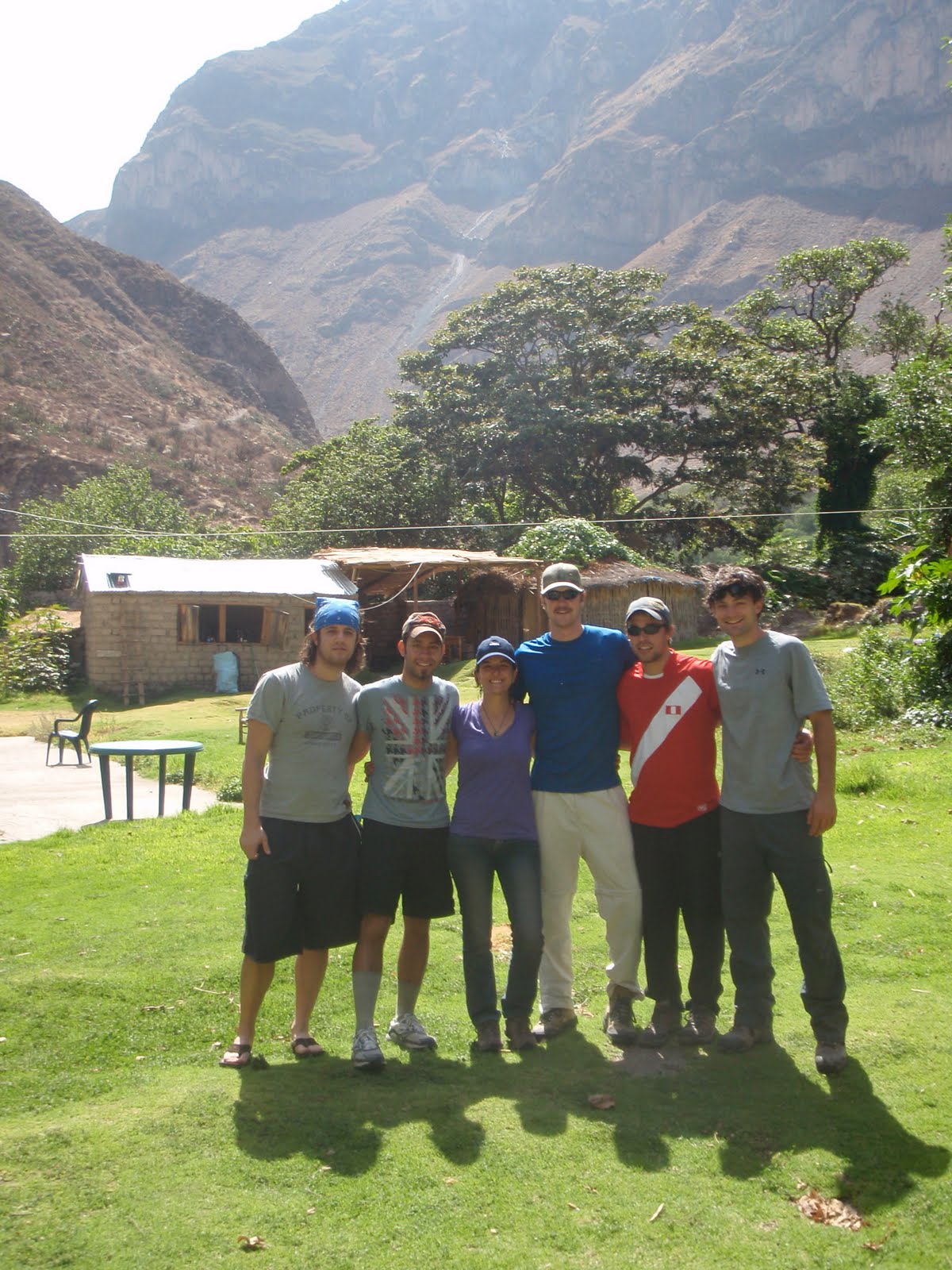
I just got back from a much-needed vacation to Arequipa, a dynamic and stunning department in the South of Peru. I spent the first few days of my vacation in the Colca Canyon with Edson, John, Ryan, Jon and Matt. We hiked to a beautiful oasis down in the canyon where we took in the beautiful surroundings, swam in oasis pools, avoided Pishtakos and Fish Tacos, sunbathed, and hiked around (Ok, some more than others).

I celebrated Thanksgiving Day in Arequipa City with about 20 other PCVs from all over Peru. I started my day picking up an iced-coffee at the Cuzco Coffee Company with Ancash Shannon and then went for a beautiful tour at the Monasterio de Santa Catalina with Edson. Then Ryan and I took my God-Dog Chewy on a little stroll to the Plaza de Armas and watched him stumble over himself playing with the pigeons in all his adorableness. At around 10am, I met a bunch of volunteers in the hostal kitchen and helped make our Thanksgiving feast - complete with stuffing, cranberry, salads and pumpkin pie. Once lunch was ready, Julie and I made a small Thanksgiving speech... and then we ate, and ate, and ate. Although there was no turkey present, lunch was delicious and a great taste of home. We hung out on the hostal rooftop patio all afternoon and enjoyed the gorgeous view of the city and surrounding volcanoes. We played pass-the-ipod and ended the night dancing in the bars on San Francisco. All in all, Thanksgiving was delightful. :)


Most Arequipeños say that Areqipa is the REAL capital city of Peru, and now I know why. The second largest city in Peru, the colonial structures are built from a white volcanic rock called sillar that glistens in the sun. Arequipa City is gorgeous and clean, Arequipeños are very friendly, and Andean culture and history can be seen everywhere. From the Monasterio to the Cathedral and the Mummy Juanita museum, I truly felt the Andean and Incan roots living on in the city. At an altitude of about 2700 meters, Arequipa is sunny almost year round and barely effected by the rainy season. All I can say is Arequipa is amazing and they are definitely Arequipin' it Real. But Ancash is Better. ;)

I spent the rest of the weekend walking on the beautiful streets of Arequipa, getting my fill of iced-coffee and rocoto relleno, spending quality time with some of my favorite Peru 11ers, and watching the sunsets on a rooftop bar on the Plaza de Armas in a Poncho while sipping on Pisco Sours.

***
Total time in Peruvian buses this week: 72 hours, and well worth it*
Total doses of Cipro taken: 1
Number of Pisco Sours drank: Hmmm...
Total sunsets viewed from atop the Plaza de Armas: Not enough
Number of "That's what she said" jokes played out: I couldn't count if I tried
Number of new God-Puppies acquired: 1, Chewy

A link to my pictures from my trip
http://www.facebook.com/album.php?aid=2176808&id=7403642&l=3352d4a421

Wednesday, October 21, 2009

Projects Update

Work has been so busy lately! After the Social Theater In-Service Training in Lima, I came back to Tumpa and completed my Improved Stoves project. Now, 10 women are proud owners of their new stoves and will be cooking in a clean, smoke-free environment from now on. What's unique about this particular project is that my participants purchased their own stoves instead of receiving them for free as part of a grant or an NGO donation. The small and poor communities in Ancash receive so many donations, fueling the culture of dependency. I asked my participants to prioritize their finances, and instead of spending their hard-earned money on frivolous purchases, to spend it on something life-changing and worth while like an Improved Stove. They're happy, I'm happy.


This week, I'll be finishing the first draft of the Social Theater Manual. It involves a lot of writing and research and makes me feel like I'm back in college. I'm also finishing up a Peace Corps Partnership Program grant for my Healthy Schools Project. This project has the most potential to be sustainable and effective. I'm requesting a grant for materials and supplies to support healthy hygiene, nutrition and environmental practices among the youth in Tumpa. We're working with the Santa Fe school and its 500 students, training the teachers, giving classes and workshops on hygiene and nutrition practices, and forming student health promoters, all with the goal of improving and developing healthy lifestyle practices. Once the grant is on the Peace Corps website, I'll be sending out emails, blogs and smoke signals with more information asking for support and donations to my project.


On top of this paperwork, I'm still going strong with my self-esteem workshop. I've been working with 90 kids between 8 and 12 years old for the past 4 months. The favorite part of my day is walking into that Primary school and getting bum-rushed by what seems like a million screaming kiddies smiling and yelling, "Sofia! Sofia!"
Last week, I celebrated Global Hand Washing Day by giving 5 different workshops on hand washing. The kids loved it - think: soapy suds, water fights, and squealing children. Soon the kids will have soap and soap dispensers in their bathrooms (thanks to the donors of my Healthy Schools grant!), so they'll be able to wash their hands every day.


This week I organized a Nutritious Food Competiton in the Secondary School to provide a fun and interactive way for the kids to learn about nutrition. 257 students participated in 10 different grade sections by creating the ideal and nutritious meal. I invited 3 women from the Health Post, Rabbit and our new Regional Coordinator Nelly to be my judges. We tried delicious and creative nutritious local foods including mazamora de quinoa, tortilla de chocho, causa de verduras y pollo, and aguitas de manzana y menta. The kids did a great job, and the winning class (5B) will receive a private cooking class with yours truly! I'm going to teach them how to cook my favorite comfort meal - Spaghetti with a classic tomato sauce, garlic bread, salad, and desert. I haven't decided what to make for the desert, so if you have any simple and delicious ideas, email me!


I'm having a great time these days and making the most of my productivity until mid-December when the school year ends. I'll celebrate Christmas in Machu Picchu with BOTH of my beautiful parents, reign in the New Year in Ancash with Grant Picarillo and his +1... and do everything I can to stay busy during the slow, rainy months of January and February - I'm hoping to take Round 2 of Quechua classes for a couple weeks and develop a Summer School program for the kids that decide to stay in Tumpa.
October is almost over, and I'm looking forward to celebrating Halloween Huaraz-Style. My costume is a SURPRISE, but I promise to post pictures after our Halloween celebration.

As always, Sending lots of Peruvian love,

Sophie

PS: For more pictures of my little rascals... http://www.facebook.com/album.php?aid=2171787&id=7403642&l=2391b14eaa

Wednesday, October 7, 2009

Here's to Family


On August 11, 2009, Carlos Alberto was born into this Peruvian world and became the newest addition to my host family!
...Here's the story.
Angelica is my 38 year old host mom and works as a farmer in Ancash. She never graduated from high school because she became pregnant at 17 to Juan Carlos, my host brother who is in Army school in Lima. A few years later came my beautiful host sister, Maria, 14. She's got a couple more years of high school to go, and if I have anything to do with it, she won't be getting knocked up like her mother, and will be going on to University in Huaraz or Lima to become a professional young Peruvian woman. Alberto is my host dad. He really doesn't bring much to the family, and I don't want to badmouth him on my blog so I'll leave it at that. So earlier this year, Angelica started to put on weight. We all just thought she was putting on weight, but around June, she discovered that she was indeed 5 months pregnant! (Sex-ed is severely lacking in this part of the world.)
At 7 months, Angelica's water broke, and she gave birth to a premature Carlos Alberto. He's now almost 2 months old, eats ravenously, sleeps like a Dila, and cries just enough to let us know he's a tough little man.
Last night, in our adobe kitchen, Angelica asked me if I would be Carlos' Godmother. I squealed, accepted, and gave her a huge hug - something she's still not quite used to yet. I'm going to lay so much loving on this little man over the next year, and as his Godmother, he and this beautiful family will be a part of my life for the rest of my life. So Here's to Family, all around the world.

Sunday, September 20, 2009

Mid-Service Conference and Social Theater


I spent last week in Lima for my mid-service conference. I reconnected with my Youth Development Peru 11 group, I checked in with my doctors for a physical and a mandatory flu shot - ouch! and I co-facilitated a 3 day Peace Corps In-Service Training workshop with Alex, another volunteer. The week was a blast. It was great to be in Lima with my Peru 11 friends, catching up, eating great food, playing mafia (so fun!), watching a little American football, and relaxing.

But the highlight of the week was definitely the training workshop.

The name of the workshop was Social Theater in Service to Community, and Alex and I taught 27 Peace Corps volunteers and community partners from all over Peru how to use theater and improv with youth to boost creativity, self-confidence, and leadership skills in the youth and to address important social issues in a community. It was so exciting to use all the drama and voice skills that I learned as a student in Connecticut with Peruvian nationals and my peers in the Peace Corps. So during three days, the participants played and endless number of improv games and dynamics, developed characters, wrote and performed monologues, and created and performed 15 minute socio-dramas on common Peruvian social issues like domestic abuse, low self-esteem, malnutrition, and teen pregnancy. Social Theater is an excellent teaching methodology, and a great way to address issues in Peruvian commuities that prevent healthy development from occuring. Everyone loved the workshop, and I feel really great about it!

The next step is that I will help create a Peace Corps manual on How to lead an IST on Social Theater in Service to Community. The idea is to make this training session accessible and available to Peace Corps programs worldwide, so that volunteers can bring Social Theater to their communities.

Well that's all for now. Be well!

Sophie

Here's a link to more pictures from my week in Lima....
http://www.facebook.com/album.php?aid=2169375&id=7403642&l=3bb3b1b961